

Read the statements and say if you agree or disagree with them. Say why you think so
1. Most people will choose a job with more money even if they will feel unhappy there.
2. Changing a job every year is OK in the 21st century, working all your life for one company is strange.
3. It’s a good idea to listen to family’s and friends’ advice when you choose a new job.
4. There’s a big competition, so companies can quickly find new workers with good skills if necessary.
What’s important for you?
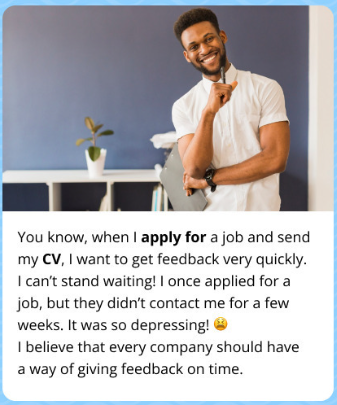
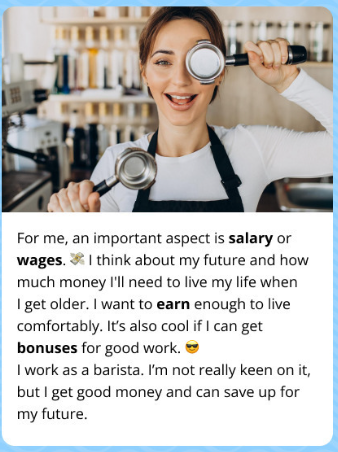
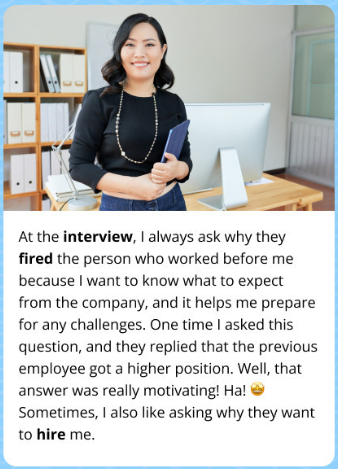
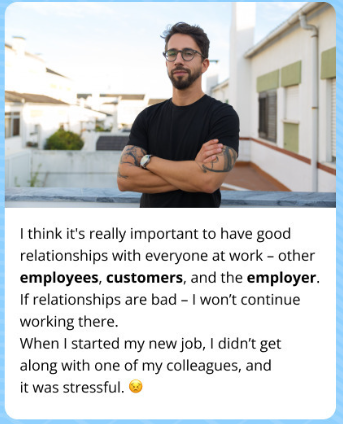
Read the comments, paying attention to the words in bold, and answer the questions
Find the word that means…
- give somebody a job.
- a person or company that pays people to work for them.
- money that you get every week for the work you do.
- money that you get every month for the work you do.
- to ask somebody to leave their job.
- get money for the work that you do.
- a document in which you describe your work experience.
- to ask for a job in some company.
- a meeting in which you ask and answer questions to find out if the job is suitable for you.
- a person who buys products or uses services.
- a person who works for somebody.
- extra money that you get for good work.
Choose the correct option to complete the sentences
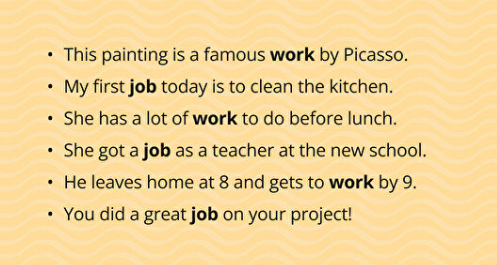
Read the sentences above and determine the meaning of JOB and WORK
Complete the sentences with WORK(S) or JOB(S)
Listen to the audio:
Arrange the paragraphs in the correct order
Listen to the audio again and determine if sentences below are TRUE or FALSE
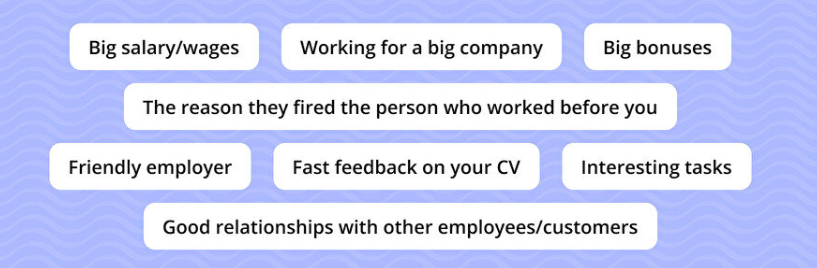
Rate the aspects of choosing a new job from 1 (the most important) to 8 (the least important). Explain your choice
Complete the sentences with the missing words from the list
WORK or JOB?

What are your skills? What are you good at?
Answer the questions below
- 1. What are some things you are good at? (e.g. playing musical instruments, cooking, speaking different languages)
- 2. Do you have any technical skills? What are they?
- 3. What are some skills that you believe are important in the workplace?
- 4. What skills would you like to improve or learn in the future?
Match the words describing the skills with their definitions:
Read the article. Match headings with the correct paragraphs
Answer the questions
- 1. What hard and soft skills do you need to be a good expert?
- 2. Why is it important to set goals for improving hard and soft skills?
- 3. How can you continue learning and developing your skills?
- 4. How can you find a balance between your hard and soft skills?
Modal Verbs
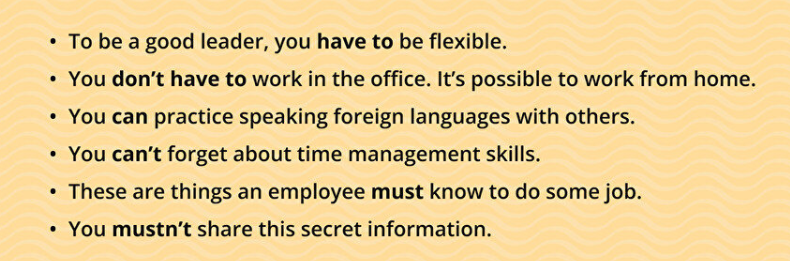
Read the sentences in the picture and match the modal verbs with their meanings
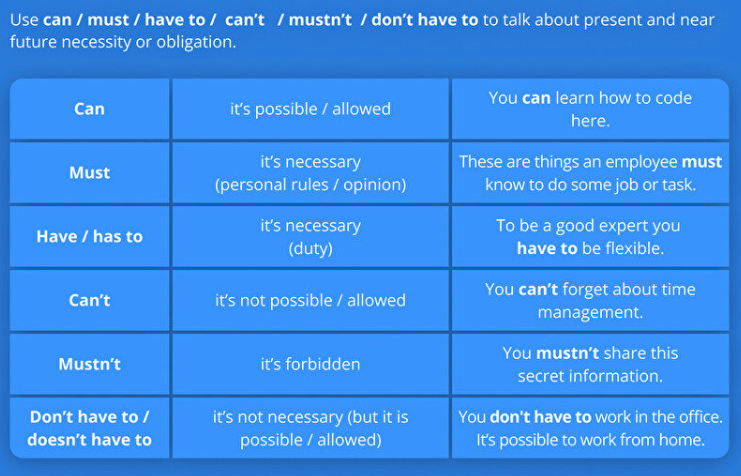
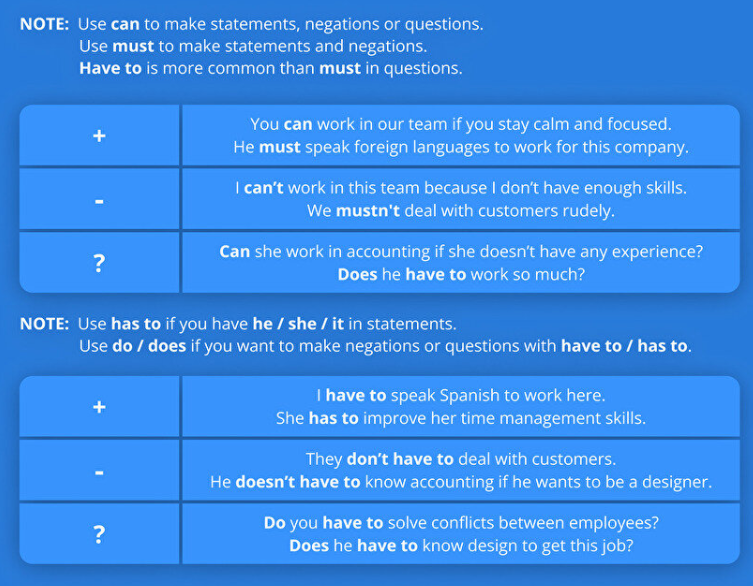
Practice use of modal verbs
Complete these sentences with the words from the lists
Put the words in the correct order.
- 1. you / with / Can / deal / customers / ?
- 2. a solution / to the / Can’t / you / problem / find / ?
- 3. be / tomorrow / at the meeting / Do / have to / you / ?
- 4. have to / your friend / work / Does / this week?
- 5. bring / Do / your ID card / you / to the office / have to / ?
- 6. you / be / Can / team leader / a / ?
- 7. foreign languages / Do / you / speak / have to / ?
Look at the list of jobs and think what hard and soft skills they need. Say why they need these skills
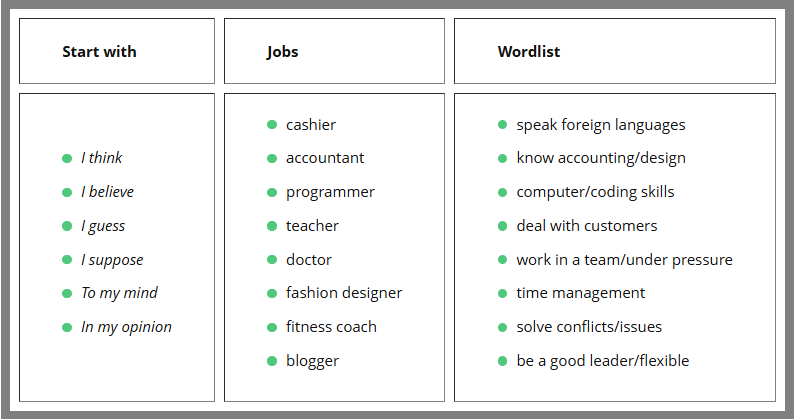
Choose the correct options
Choose the correct modal verb form
Think about any five numbers from 1 to 25. Answer the questions with these numbers
- 1. Name three skills you need to do your job successfully.
- 2. What steps do you have to take to improve your career?
- 3. Do you sometimes have to solve conflicts at work?
- 4. Can you ask your employer to deal with your issues?
- 5. What does your best friend have to learn to be a good leader?
- 6. Do you prefer to work in a team or alone?
- 7. Is there anything you mustn’t do at work?
- 8. What do you have to do to make your time management skills better?
- 9. Can you share an experience of dealing with a conflict at work?
- 10. How important is it to be flexible at work?
- 11. What steps are you taking to improve your communication skills?
- 12. Can you describe a situation where you worked under pressure?
- 13. Is it necessary for you to have basic knowledge of accounting or design? Why/why not?
- 14. What skills do you think are important for dealing with customers?
- 15. Do you believe that being a good leader is a necessary skill in your job? What other skills are important for you?
- 16. Can you think of a situation when it was important to be flexible because of changes?
- 17. What are the skills that you don’t need in your profession?
- 18. What foreign languages do you have to speak at work?
- 19. What steps can you take to be a better leader?
- 20. Can you think of a situation when you didn’t have enough skills to do the task?
- 21. Is it necessary for you to have basic knowledge of computers and technology?
- 22. What tasks can you ask your colleagues to help you with?
- 23. What can you do to solve conflicts better?
- 24. Name three things you mustn’t say or do when you deal with customers.
- 25. Name the best leaders you have ever known.
Complete the word combinations and use these collocations to make sentences about your job.
Meet Bob!

Hi there! Welcome to my profile! I’m Bob, a hard-working programmer at iTechGenius. I am keen on technology and solving problems.
I enjoy working in a team because I believe that it helps to get better results.
I’m always ready to learn and improve my hard and soft skills. I’m crazy about learning foreign languages. I can speak Spanish, English, and German. Now I’m learning French. One of my hobbies is traveling. My dream is to visit all countries in Europe in one year.
If you’d like to discuss anything about information technology, traveling or language learning, feel free to contact me.
Choose the correct option
What is Bob’s problem? Listen to the audio and answer the questions below.
- 1. What’s Bob’s problem?
- 2. How is he going to solve it?
- 3. What does Bob mean when he says ‘remote’ work?
- 4. Which type of work is better: in the office or remote?
Match the words with their definitions

Read the message from Bob’s friend David and choose the correct options
Listen to Bob’s friend Alice and complete the statements

Divide the following ideas about working from home into the positive and negative ones
- You can sleep more.
- It’s boring.
- No commute.
- You’re productive.
- Many distractions.
- You’re flexible.
- Traveling chances.
- Some issues with the schedule.
TOO or ENOUGH
Read the sentences and complete the rules below
- I’m too tired now. I will finish this project tomorrow.
Bob does not travel enough.
I had too many distractions.
He speaks too slowly.
I have too much work to do.
I did not have enough time to chat.
She’s productive enough.
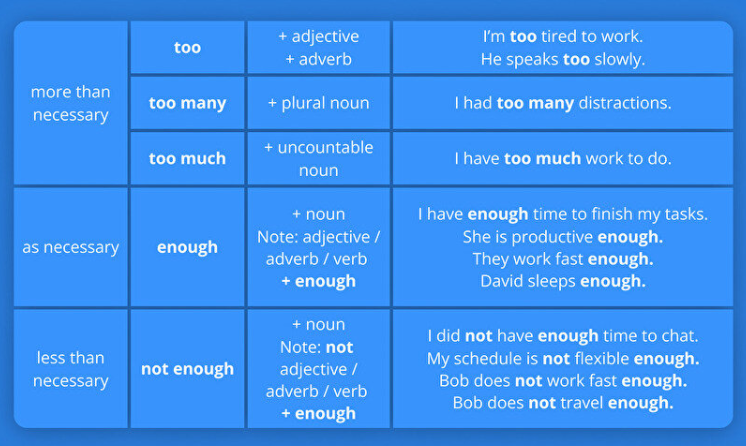
Let’s practice!

Listen to Bob’s friend James and choose True or False
Prepositions used when speaking of time
Complete the rules below with the missing words
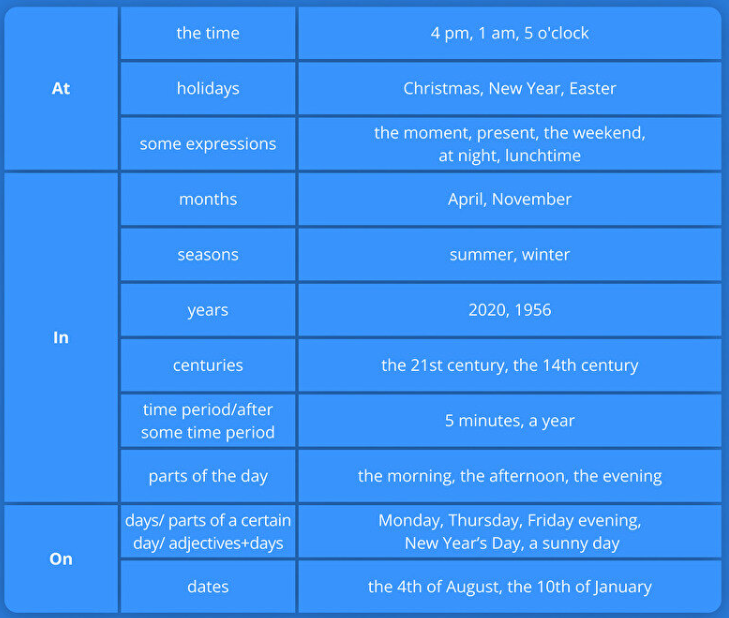
Now, let’s practice
Complete the questions with AT / IN / ON and then answer them
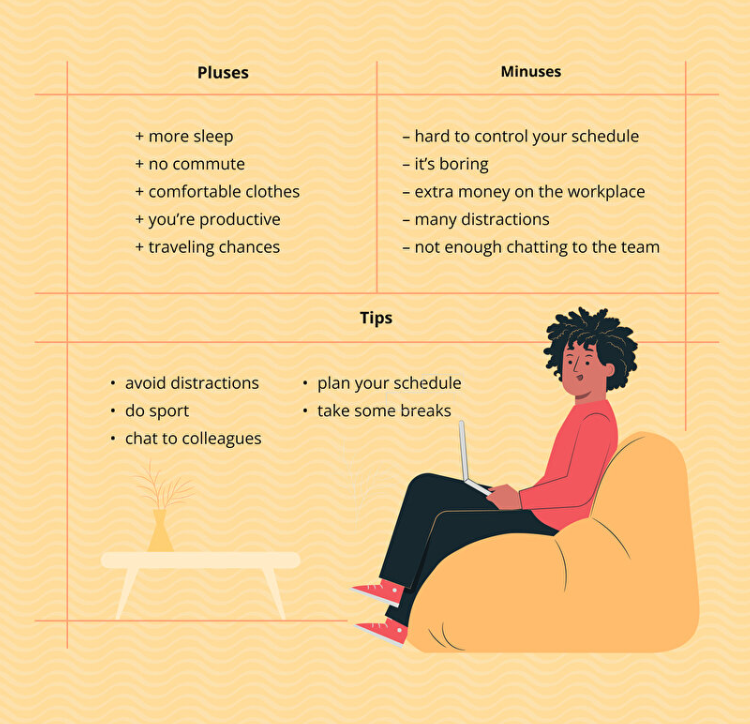
Look at the table and answer the following questions
- 1. What other pluses and minuses can you add?
- 2. What else can you recommend to Bob if he works from home?
- 3. What about you? What do you prefer? Why?
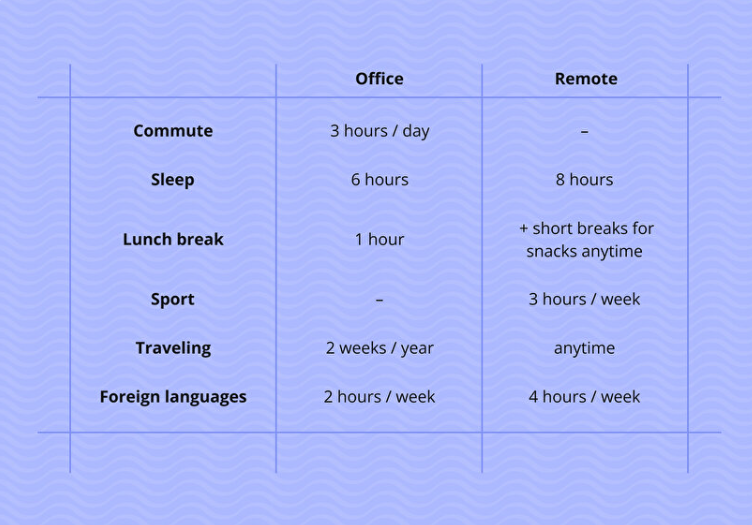
Look at Bob’s table and correct the sentences below
- 1. Now, Bob feels too tired because he spends not enough hours commuting.
- 2. He believes he can’t sleep enough when he works from home.
- 3. Bob can travel often enough because he works in the office.
- 4. He won’t be happy enough when he has remote work because he can spend more time learning foreign languages.
- 5. Bob doesn’t have enough time for sport because he spends not enough time on the commute.
Fill in the gaps with the correct prepositions of time (in, on, at)
What’s your job?
- a barista.
- a nurse.
- an ice cream seller.
- a chef.
- a doctor.
- a designer.
- a hairdresser.
- a teacher.
Fill in the gaps with the words from the list:

Read the article and then choose the correct options
Over the last few years, the world has changed a lot. Companies have become more flexible about the way people work. For example, in some countries like South Africa, Belgium, Iceland, and Japan they are trying to have a 4-day workweek.
The results of this experiment are surprising. 63% of employers think it’s easier to find employees with this change. Also, 78% of employees feel happier and less stressed because they have better work-life balance and they feel more productive too.
Samuel, a full-time accountant from South Africa, is one of them. ‘You know, I’m going to retire in 2 years. And I’m absolutely excited about the chance to test this schedule. I still have a 9-to-5 job but I can take an extra free day or time off. Well, but of course, I have to work long hours when it is necessary’.
On the other hand, we can’t be sure this schedule is useful for everyone. Some of the companies failed this experiment, especially those that can’t have remote work. Employees there got more stressed than usual.
Olivia strongly believes that the working style depends on the type of job. ‘I’m a farmer. My family and I work in the gardens. We grow fruit, berries, and vegetables. And it’s a seasonal job. We work around 60-70 hours per week in the season. Well, surely, when it’s very hard we try to work in shifts, so some of us can rest when the others work’.
In conclusion, the 4-day week is definitely a positive change that allows some people to make their lives more balanced. But this way can not work for everyone. So we hope there will be new creative work styles in the near future to make people of all jobs happier.
Read the article again and choose TRUE or FALSE
Answer the questions
- How much do you work?
- How do you feel about this schedule?
- Would you like to have a 4-day workweek? Why/Why not?
Listen to the speakers and choose the correct options
Agree or Disagree?
Listen to the dialogue again and complete the phrases below
Complete the sentences using the correct options
Agree or disagree with the statements below and say why you think so
1. It’s easier to find employees if the company has a 4-day workweek.
2. Workers do 100% of their usual tasks when they have 3 days off.
3. Some employees can be more stressed because of the schedule change.
4. The hours you work can depend on your job and teamwork.
5. People who have seasonal jobs have more chances to take time off.
6. All employees are happy to have a 4-day workweek.
7. You can earn a good salary only if you work under pressure and solve many issues.
8. Part-time employees always have a better work-life balance than those who have a full-time job.
Use the following phrases to agree or disagree
- That’s true
- I think so too
- You’re right
- I feel the same
- I totally disagree
- I’m not sure about that
- I don’t think so
- I doubt it
Choose the correct option to complete the sentences
Agree or Disagree?
A good way to say “Goodbye!”

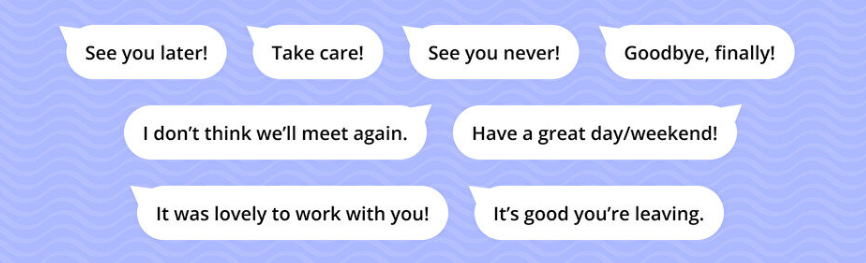
Read the story, complete it with the missing words from the list
Read the text and discuss the questions below
When it’s time to say goodbye
When the time comes to say goodbye to your job, it’s like closing one book and opening a new one. Your last day can be an incredible adventure. Here’s a fun way to spend it!
First, make cleaning your workspace a game! See how fast you can put all your things into a box. Leave your desk clean enough for the next person who will sit there.
Then, start the “Goodbye Quest.” Go on a mission to say goodbye to your colleagues. It can be too sad sometimes, so try to say something nice to each person, for example, “I will miss your jokes,” or “Remember when we finished that big project together? That was great!”
Create a little treasure for your boss, too! Write a thank-you note. It doesn’t have to be long. In it, tell your boss about your favorite moment at work or the best thing you’ve learned. Don’t forget to thank them for the chance to work there.
Next, the “Goodbye Feast.” If you can, make a little get-together with your team. You could even have a cozy party with everyone’s favorite food. Share your favorite stories about your time together.
Before you finally leave, check your desk again. Make sure you’ve got all your things. Return any stuff that belongs to your office. This could be your final quest!
At the end, gather everyone for the “Big Goodbye”. Tell them you’re sad to go, but also excited about your next adventure. And then, like a movie star, walk out with a big smile, ready for your next big role!
Remember, goodbyes can be hard, but it’s not just an end – it’s also a new start!
- What should you do with your desk on your last day?
- What kind of message can you write to your boss?
- What can you say to your colleagues when you say goodbye?
- What food would you bring to a goodbye party?
- What would you say to your coworkers?
Complete the sentences below
What to say?
Complete the comments with the words from the list
When are you leaving? Complete the sentences with at, in, on
Watch the video and correct the sentences below
- Zou’s colleagues were rude enough when he packed his things.
- Everyone in the office was too busy to say goodbye.
- Zou’s colleagues had too much time to prepare a goodbye surprise for him.
- Too many people came to the office to say goodbye to Zou.
- There wasn’t enough space for all colleagues who wanted to say goodbye to Zou.
- Zou wasn’t happy enough when he saw the presents.
- He was too anxious to take the presents.