

Look at the list of subjects and answer the questions below
1. Which subjects did you like and dislike when you studied at school? Why?
2. Which of these subjects was the easiest and the most challenging? Why?
- art
- foreign languages (English, etc.)
- history
- IT (information technology)
- literature
- maths
- geography
- PE (physical education)
- science: physics, chemistry, biology
B13.1_Read the comment below and choose True or False
Hello, beautiful people! Sophia’s here!
I’m on a special mission – I need to find the best school for my little champion!
But wow, who knew there were so many different education systems out there?!
So, I thought, who better to ask than the people who know these systems really well – the teachers!
First off, I met Ms. Sally from a Montessori school. She told me about this system where kids can learn at their own speed. It’s like a fun playground of learning! Sounds cool, right?
Then, Mr. John from the Waldorf school shared how their system focuses on the kid’s creativity. He said, “We let them dream and turn those dreams into reality!” That sounds awesome too!
And let’s not forget Mr. Lee from the International Baccalaureate (IB) school. He said, “We believe in a broad and balanced education for everyone. It’s like having a taste of everything in one meal!”
Phew! And this is just the start! I’m going to explore more, ask more teachers, and then decide which one’s the best fit for my champion!
Isn’t it a fun challenge? Keep following for more fun updates!
B13.2_Choose the correct options to complete the definitions
B13.3_Let’s practice new vocabulary
B13.4_Read the comment and answer the questions below
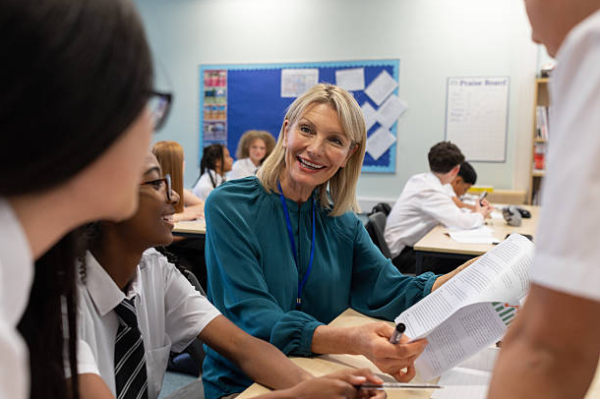
Hi there! I’m Ms. Joy, a teacher at a secondary school, where we follow the Sudbury model. We are totally democratic here, we respect every opinion. Decisions at our school aren’t made by teachers alone. Nope! Everyone makes them – students and teachers. What else? Subjects are chosen by the students themselves. They follow their own interests. The lessons aren’t just given to them, they’re created by them. Kids choose their subjects – how cool is that? Last year, we even created a whole project on dinosaurs controlled by a student. Then, traditional tests are replaced by real-life experiences. And guess what? We don’t let bells change our day. We believe free time can spark the best ideas! Say ‘NO’ to taking notes after a boring teacher, and choose FUN.
- What is the main feature of Ms. Joy’s school?
- Who chooses the subjects for studying?
- What kind of tests do the students have?
- What is special about the schedule at this school?
B13.5_Read another comment and choose the correct options
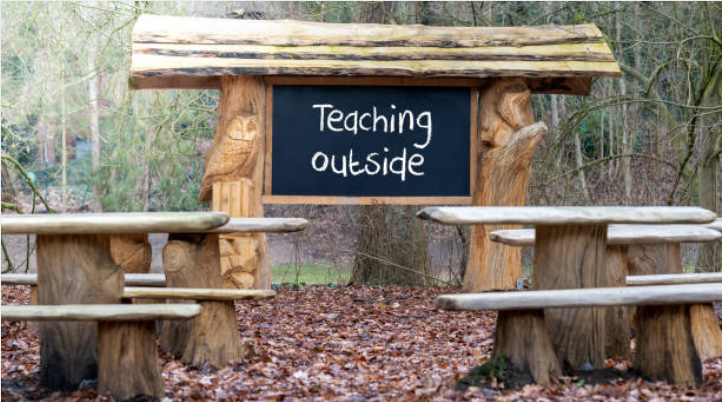
Hello, I’m Mr. Winsent, a proud teacher at one of the primary schools. It’s a fantastic forest school in Denmark! Our classroom is the forest! Lessons aren’t given inside four walls, we give them under the open sky during any term or semester. Here, children learn by exploring nature. They discover their strong points and skills by building real things, like that time when a large treehouse was built by our students themselves!
In our school, children don’t learn only how to take notes. They have many challenges to learn how to solve problems. It’s embraced safely under our careful eyes. They also learn to love and respect nature as they watch the seasons change and see the forest’s beauty every day.
B13.5_Read the next comment and complete the sentences below
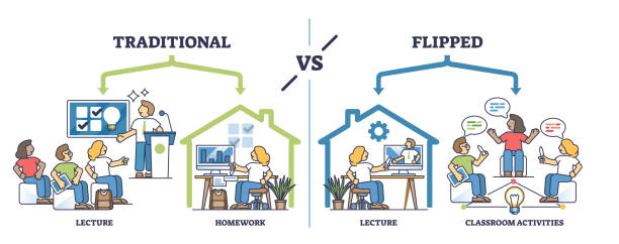
Hi there! I’m Mr. Connor, a retired teacher. I taught using a cool method called the flipped classroom. You see, in my classes, the usual teaching style was totally changed. The students didn’t learn new topics in class; they learned them at home first.
Here’s how it worked: I gave them lesson materials, like videos and articles, to study before the lesson. Then, in class, we explored it deeper! We had chats, solved problems, and used what was learned at home. Once, a challenging physics idea was easily understood by my students, because they had studied it at home first!
Sounds fun, right? That’s the magic of flipped learning!
- Mr. Connor used…
- It’s a method when…
- Students had to…at home.
- At the lessons they…
B13.6_What advice can you give to Sophia?
1. Which school do you think is the best for modern learners?
2. What would you choose if you were Sophia? Explain your choice.
3. If you were a student now, which school would you prefer?
B13.7_Choose the correct options. Do the task orally
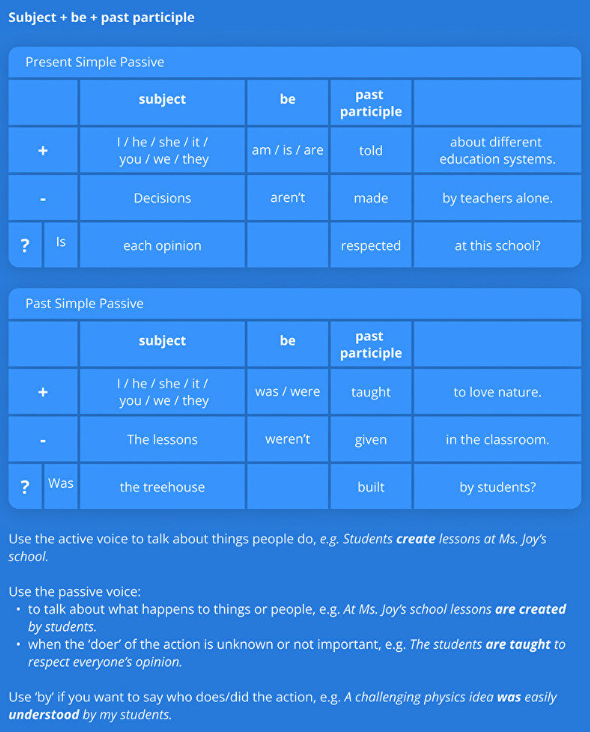
Active: At Ms. Joy’s school, students create lessons.
Passive: At Ms. Joy’s school, lessons are / is / am created by students.
Active: Mr. Connor gave lessons in the forest.
Passive: The lessons was / were / be given in the forest.
1. Use the active / passive voice to talk about things people do.
2. Use the active / passive to talk about what happens to things and people.
3. Use the active / passive when the “doer” of the action is unknown or not important.
4. Use “subject + be + Present Simple / Past Participle” to make the passive voice.
5. Use with / by when you want to say who does/did the action.
Present and Past Simple Passive
B13.8_Choose the correct options
B13.9_Make passive sentences using the prompts below. Use ‘by’ where it’s necessary. Then, think which sentences are true for you
1. When I studied at school / we / not, allow / to choose subjects.
2. Challenging ideas / explain / to us / our teachers.
3. All decisions / usually / made / students and teachers together.
4. Many amazing things / create / me and my classmates.
5. Everyone’s opinion / respect / at my class.
6. I can’t say that each topic / understand / me / when I was a child.
7. We / tell / nice stories / our teachers.
8. I’m sure skills / better / develop / when you have a lot of freedom.
B13.9_Choose the correct verb form
B13.10_Complete the sentences following the prompts in the brakets
B13.10_Make sentences in Present and Past Simple passive
Example: I / tell / education system. – I am told about the education system. / I was told about the education system.
1. Teachers / replace / gadgets.
2. Lessons / create / for students.
3. We / tell / story / teacher.
4. Notes / take / this semester.

B13.11_Answer the questions below
Have you ever
- had any English-speaking friends or colleagues? How did you communicate with them?
- watched movies or listened to songs in English? Which ones did you enjoy?
- read anything in English, such as books or websites? What kind of things did you read?
- used English on social media or when chatting online? Which platforms did you use?
- traveled to an English-speaking country? How did you use English during your trips?
- taken part in any English-speaking groups or events in your area? What kind of events were they?
- used English for any hobbies or interests? If yes, what did you do in English?
B13.12_Let’s master new vocabulary. Match the words/phrases to their definitions
B13.13_Complete the sentences below with the correct phrases from the list
B13.14_Answer the questions below
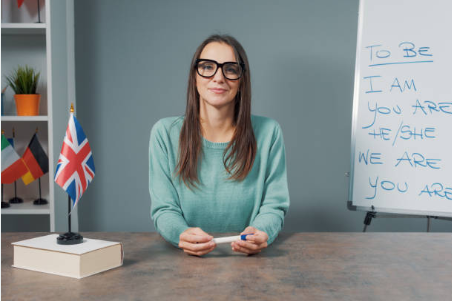
1. What might be the reasons to learn a new language?
2. What difficulties might language learners have?
B13.15_Listen to the dialog and complete the sentences with the phrases from the list
B13.16_What would you recommend Jessica do to improve her Spanish? Make a list of 5 tips. Use the prompts below
- I believe, Jessica has to …
- It’s important for her to …
- It would be good to …
- It’s also necessary to …
- I’m sure she …
B13.17_Listen to the second part of the dialog and say which tips from the list below you hear
- Be patient.
- Watch cartoons.
- Listen to Spanish songs.
- Keep pushing.
- Make flashcards.
- Write simple sentences every day.
- Learn grammar first.
- Please remember: one step at a time!
- Enjoy the journey.
- Don’t give up!
- Go to Spain.
- Don’t talk to locals.
- Don’t listen to the news!
- Ignore listening practice.
B13.18_Listen to the dialogue again and choose the correct options

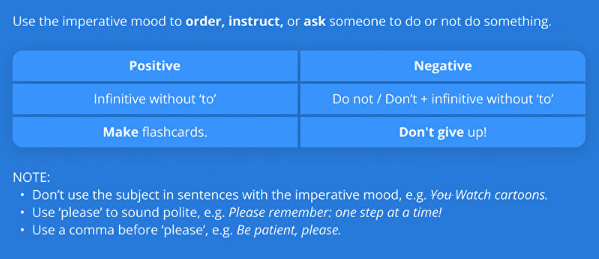
Imperative Mood

B13.19_Read the sentences and complete the rules with the words from the list
B13.20_Complete the comment below with the words from the list
B13.21_Make rules about learning using positive or negative imperative forms of the verbs in brackets
Example: (To be) afraid to make mistakes. → Don’t be afraid to make mistakes.
1. (To practice) regularly to improve your language skills.
2. (To use) the language everywhere to get fluent.
3. (To set) hard goals to stay motivated in your language learning journey.
4. (To learn) only grammar.
5. (To make) a long break in the learning process.
6. (To use) language learning apps or websites to get useful materials and exercises.
B13.22_Make positive or negative imperative sentences using the prompts below. Use “please” where it’s necessary
e.g. Learn all the words by heart. It can help you explain your ideas clearly.
- learn by heart/poems;
- get fluent/foreign language;
- improve/grammar skills;
- make flashcards/new words;
- look up/unknown words.

B13.23_Read the text about this game and answer the questions
Wheel of Fortune
Wheel of Fortune is an exciting game show that has been on TV for a long time. The game is about solving word puzzles to win prizes. It’s a lot of fun, and you can play along at home too!
Here’s how to play:
1. Spin a colorful wheel with money and special spaces.
2. Call a letter like “B” or “D”. If it’s in the puzzle, it shows up.
3. Solve the puzzle, like, “This is a person who takes care of teeth and helps to fix them”. Your job is to guess the missing letters. For example, “D______”. Win money for the right letters.
4. Buy vowels (A, E, I, O, U) to help. They cost some money, but they can help to solve the puzzle.
5. Be careful! There are some tricky spaces on the wheel, like “Bankrupt”, where you lose your money, or “Lose a Turn”, where you miss a chance to play.
6. Bonus Round. It’s the final round that gets you the special prize.
So, that’s how you play Wheel of Fortune! It’s a fun game that tests your word skills and can win you cool prizes. Enjoy playing and have a great time!
- What is the aim of the game?
- What is the wheel used for?
- What happens when a player guesses the correct letter in the puzzle?
- What can you do with vowels?
- When can a contestant lose all their winnings for that round?
- What happens at the Bonus Round?
B13.24_Listen to the people playing “Wheel of Fortune” and fill in the gaps with the correct answers
B13.25_Listen to the final part of the show and choose the correct options
B13.26_Complete the definitions with the correct words
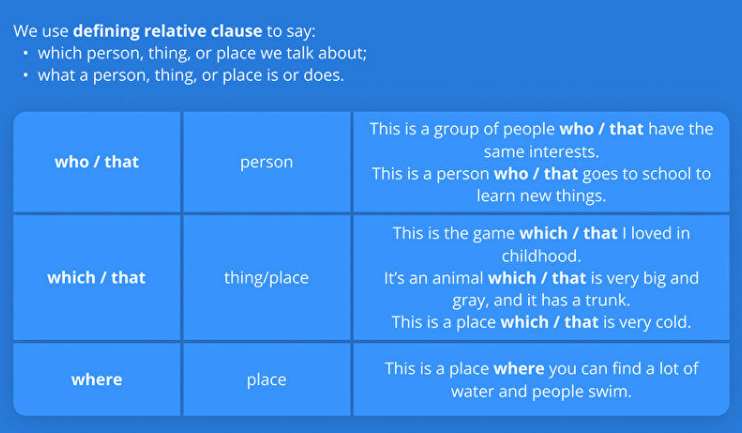
B13.27_Read the sentences below and complete the rules with the words from the list
1. This is a group of people who have the same interests.
2. This is a place where you can find a lot of water and people swim.
3. It’s an animal that is very big and gray, and it has a trunk.
4. This is a person that goes to school to learn new things.
5. This is the game which I loved in childhood.
6. This is a place that is very cold, and where we find a lot of ice and snow.
Defining relative clauses (who / which / that / where)
B13.28_Complete the sentences with WHO / THAT / WHICH / WHERE
B13.29_Match the words with their definitions
B13.30_Complete the definitions with the words from the list below. What words do these definitions describe?
B13.31_Complete the definitions below
1. Schedule: It’s something…
2. Classmate: It’s someone who…
3. Vehicle: It’s a kind of …
4. Pharmacy: It is somewhere…
5. Win: For example, you do this…
6. Polite: It’s the opposite of …
B13.32_Make the words using these letters
B13.33_Complete the sentences
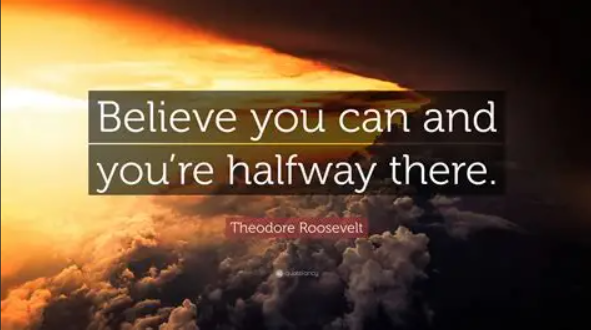
B13.34_Read the quote below and answer the questions
1. What does this quote mean to you?
2. Do you agree or disagree with the quote? Why?
B13.35_Match the words with their definitions.
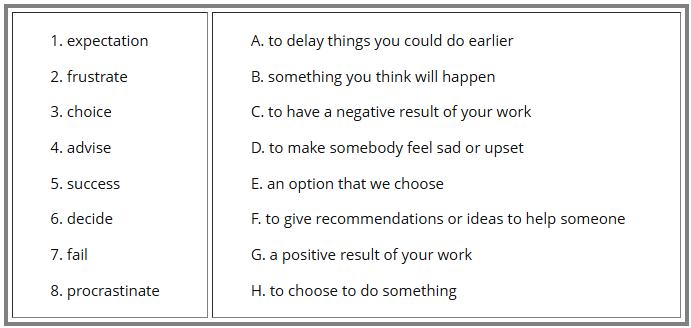
B13.36_Complete the sentences with the words from the list
B13.37_Read the introduction of the article and guess what it’s going to be about
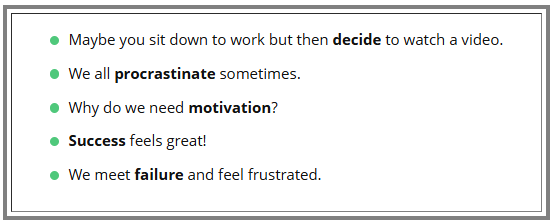
Do you ever feel like you want to do something but just… don’t? Maybe you sit down to work but then decide to watch a video. Or perhaps you think about exercising but then choose to eat chips. Welcome to the club! We all procrastinate sometimes. But the good news? There’s a solution! It’s called finding your motivation.

B13.38_Read the whole article and choose True or False
Why you need motivation and how to find it
Do you ever feel like you want to do something but just… don’t? Maybe you sit down to work but then decide to watch a video. Or perhaps you think about exercising but then choose to eat chips. Welcome to the club! We all procrastinate sometimes. But the good news? There’s a solution! It’s called finding your motivation.
1. Why do we need motivation?
Life can sometimes be like a roller coaster. It has its ups and downs. Success feels great! But, what about those times when things don’t go as we expect? We meet failure and feel frustrated. It’s easy to stop trying or give up. But motivation can help! It’s like the fuel in a car. It keeps us moving forward, even when the road is hard.
2. How can we find our motivation?
Listen to your heart. Maybe you love music, books, sports, or cooking. Do more of that! It can help you feel happy and ready to face challenges.
Set small goals. Big goals can be scary. But small steps? They’re fun! For example, if you want to read a book, start with one page a day. Celebrate every small success!
Talk to friends and family. Sometimes, we just need to share our feelings. They can give advice, tell a joke, or just listen. It can help a lot.
3. Decide and choose your path.
Remember, it’s your life. You can decide what you want to do. You can choose to keep going, even when things are tough. When you have motivation, you can turn frustration into action. You can turn failure into a lesson. And most importantly, you can turn dreams into reality.
In the end, motivation is like a magic key. It opens doors to new adventures and stories. So, next time you feel like you want to procrastinate, think about your motivation. Find it, hold it tight, and let it lead you to success!
B13.39_Look through the article again. Which ideas from it do you agree and disagree with? Why?

B13.40_Look at some sentences from the article. Are the words in bold verbs or nouns?
B13.41_Complete the rules with the correct verbs
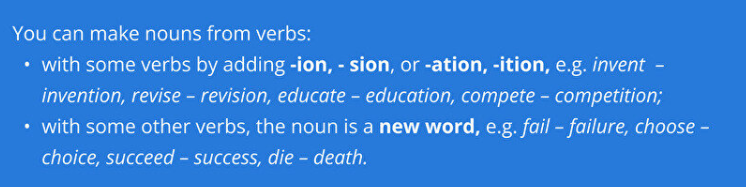
B13.42_Complete the questions below with the correct noun forms. Then answer the questions
B13.43_Watch the video and choose the correct options
B13.44_Watch the video again and answer the questions below
1. What type of motivation is naturally found inside all of us?
2. What does our brain do after taking in lots of information?
3. How can we get our brains to do things worth doing?
B13.45_Read the comments below and give advice to these people on how to find motivation
Sarah: “I find it challenging to motivate myself to exercise regularly. I know it’s good for my health, but I always feel tired after work, and I end up procrastinating.”
Alex: “I’m having trouble staying motivated to study for exams. It sometimes feels too much, and I get distracted easily, especially when my friends want to do something fun.”
Jason: “I love playing the guitar, but lately, I feel unmotivated to practice. It’s frustrating because I want to improve, but I keep getting stuck on the same chords.”
Emily: “It’s so hard to find motivation at work. The tasks seem boring, and I don’t see any progress. It’s hard to stay motivated about my job.”
B13.45_Complete the sentences with the words from the list. Then change these sentences, so they are true about you
B13.46_Write the correct forms of the words, missed from sentences
B13.47_Form nouns from the given verbs and answer the questions
Example: decide – decision

Hey there! My name’s Grace and I’m a life coach. I’ve got a question for you.
Do you know what is common between Tom Hanks and Albert Einstein?
Alright! Here’s the answer. They both had Impostor Syndrome.
- Have you ever heard of this syndrome?
- Do you know any signs of it?
B13.48_Read Grace’s article and complete it with the phrases from the list
B13.49_Read the article again and choose True or False

B13.50_Read the description of impostor types. Complete sentences with the words/phrases from the list
B13.51_Read the list of the titles and then, write the correct letters next to the titles
B13.52_Choose the correct alternative

B13.53_Read the introduction to Grace’s speech and complete it with the correct options. What advice do you think the coach can give?
B13.55_Answer the questions below
1. Which of Grace’s ideas do you think are the most helpful?
2. What useful tips can you add?
3. Have you ever felt like an impostor? What thoughts did you have?
4. How did you fight negative thoughts?
5. Who did you ask for help?
6. How do you usually reward yourself for success?